Contents
The five rules: what 75 Hard asks for every single dayWhy mark it on paper: what self monitoring does on its ownOne circle a day: why this sheet stays almost emptyRunning the sheet: decisions to make before day onePaper or an app: which job goes whereThe restart rule: what an all or nothing design costsFrequently asked questions: the printable and the rulesLast updated: 2026-09-20
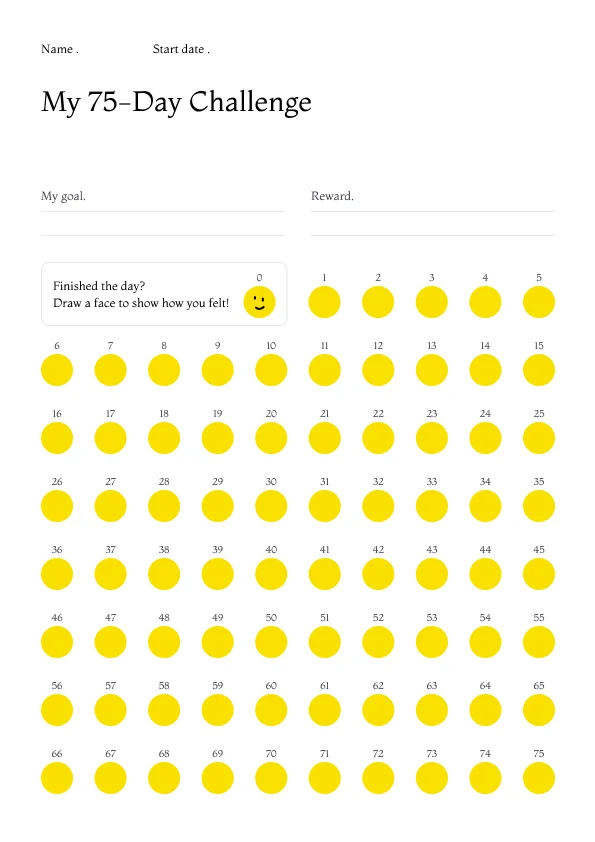
Quick answer: This free 75 Hard printable is a one page PDF with 75 circles, one per day, and you fill in a circle only after all five of that day's rules are done.
You came here for the tracker, so here it is.
Download your free 75 day printable tracker PDF
Print it, or drop it into a notes app on a tablet and mark it with a stylus. Everything below is about the rules it tracks and about where a sheet of paper stops carrying the load.
The five rules: what 75 Hard asks for every single day
75 Hard runs for 75 days and asks for five things daily, with no substitutions and no rest days. Andy Frisella, who created it, describes it as a free 75 day mental toughness program and writes plainly that this is not a fitness challenge.
Here is what the official 75 Hard rules say:
- Two workouts each day, each a minimum of 45 minutes, three hours apart, and one of the two has to be outside
- A gallon of water
- At least 10 pages of non-fiction, educational reading, and audiobooks don't count toward the 10 pages
- A diet aimed at your own goals, followed with zero deviations, zero alcohol and no cheat meals
- A daily progress picture
Two of those details are easy to miss. This page listed the workout rule without the three hour gap until today, which is one of the reasons it got rewritten. The reading rule is the other one, since the official wording rules out audiobooks explicitly.
Fail any task, on any day, and you restart the whole thing at Day 1. Day 61 counts the same as day 3.
Why mark it on paper: what self monitoring does on its own
Filling in a circle is self monitoring, and how long people keep it up turns out to depend on what is sitting alongside it. A 21 day trial of dietary self monitoring reported adherence of 0.55 in the group left to manage on their own, 0.72 with tailored feedback and 0.83 with intensive support. All three groups drifted downward across the three weeks. The self managed group fell off fastest.
That study was about food logging inside a weight loss program, so the figures don't carry over to a challenge tracker as they are. The direction is the part worth borrowing. A printed sheet puts you at the self managed end of that range. That's fine for a fortnight. Where it gets thin is week four, when the novelty has gone and nothing external is checking in on you.
One circle a day: why this sheet stays almost empty
This tracker gives you a single circle per day and nothing else to fill in. 75 circles run across one page. You write your name at the top, write down which version of the rules you are running, and colour a circle in when the day is finished.
There is a reasonable case for the opposite design. In a four week pilot, 29 people tracked six core behaviours with 11 sub items inside an app, and 95.6 percent of them completed at least 75 percent of their daily entries. The sample was small and made up of volunteers. It still shows that a long checklist isn't the thing that breaks a run by itself.
A single circle buys you speed. The mark takes two seconds, which is the difference that matters on day 52 when you're standing in the kitchen at 11pm having just finished the second workout.
Running the sheet: decisions to make before day one
Pick your version of the rules before you start, write it on the sheet, and leave it alone for the rest of the run.
- Decide whether you are doing full 75 Hard or a lighter set, and write that at the top
- Put the sheet somewhere you pass every day, not in a drawer
- Fill the circle at the same point each evening, after the last rule is done
- Keep progress photos in a dated album on your phone, since the paper can't hold those
If you haven't picked a start date yet, how to start 75 Hard walks through the first week and the things that tend to go wrong in it.
Paper or an app: which job goes where
The tracker holds the record of what you did. Timing the workouts and getting you to the second one are a different job, and a phone is better suited to that half.
| Daily rule | What the printed tracker does | What to look for in an app |
|---|---|---|
| Two 45 minute workouts, three hours apart, one outside | One circle once both are finished | A timer per session and a second cue three hours after the first |
| A gallon of water | The same circle | A numeric target you can count up to during the day |
| 10 pages of non-fiction, audiobooks excluded | The same circle | A fixed daily slot instead of a floating reminder |
| A diet with no alcohol and no cheat meals | The same circle | Very little. This rule mostly lives outside any app |
| A daily progress picture | The same circle | A reminder tied to a time of day |
There's direct evidence behind the reminder column. A meta analysis of medication adherence apps found a gain of 18.85 percentage points on the percentage adherence scale, across 14 trials and 1,565 participants. Those were medication apps, and 11 of the 14 trials measured adherence by self report, so treat it as a direction and not a number to lift across.
Routinery, the app we make, sits on the timing side of that split. It runs voice guided step timers that read each step aloud and announce the next one, with voice and push notifications you schedule by weekday and time slot, across Android as well as iOS, iPadOS, macOS (M1), watchOS and visionOS.
It also has a gap that matters here. Routinery has no numeric target field and no goal date field. We looked at the App Store listing, the product site and the update notes, and none of the three describe one. So a gallon of water and 10 pages stay a yes or no check in Routinery, exactly as they are on the printed sheet. If counting up through the day is the thing you want, use a dedicated water or reading tracker for those two rules.
For a wider look at the field, our roundup of habit tracker apps sorts them by what each one is actually good at.
The restart rule: what an all or nothing design costs
Miss one task on day 61 and the official rules put you back on day one. That rule is the reason the program exists, and it is also the part that deserves a clear head before you commit.
Researchers who interviewed people about all or nothing thinking found something relevant here. When participants couldn't meet the standard they had set themselves, 27 interviewees described choosing to do nothing at all instead of scaling the plan down. The study was qualitative and the sample skewed heavily female and heavily white, so it gives you a pattern and no rate at all.
Frisella's position is that the restart is the training. Going in knowing that the pressure is the design, and not an unfortunate side effect, is worth more than any tracker layout. Once your 75 days are behind you, what comes after 75 Hard picks up the question of where the habits go next.
Frequently asked questions: the printable and the rules
Where can I get a free 75 Hard challenge printable tracker?
The download link near the top of this page gives you the PDF at no cost and with no email required. It's a single page holding 75 circles, one per day, sized to print on standard letter or A4 paper. You can also open it on a tablet and mark it with a stylus in a notes app, which some people prefer because the file survives a house move. There's nothing to fill in beyond your name, the version of the rules you picked, and one circle per finished day.
What are the five 75 Hard rules?
The official 75 Hard rules list two workouts a day of at least 45 minutes each, spaced three hours apart, with one of them outdoors. A gallon of water. At least 10 pages of non-fiction reading, where audiobooks are excluded. A diet chosen for your own goals and followed with no alcohol and no cheat meals. A daily progress photo. The same page states the consequence directly: miss any task on any day and you restart at Day 1. No substitutions are allowed and there are no rest days built into the 75.
Can I use this tracker for one habit instead of all five rules?
Yes. The sheet has one circle per day and no fields tied to specific rules, so whatever you decide a finished day means is what the circle records. Plenty of people run a lighter version, and writing your chosen rule set at the top of the sheet is the part that matters. Deciding mid run is where things usually come apart, because a standard that moves is a standard you can argue with on a bad evening. Pick it before day one and leave it fixed.
Do I have to print it, or can I use it digitally?
Either works. Printing puts the sheet somewhere you walk past, which is most of the value of a paper tracker. If you'd sooner keep it on a device, the PDF opens in GoodNotes, Notability or any notes app that accepts PDF annotation, and you mark the circles with a stylus or a finger. The one thing worth avoiding is burying it in a folder you never open, since a tracker you can't see does nothing for the run.
Do I really have to restart if I miss a day?
Under the official rules, yes. Frisella's wording leaves no room around it, and the restart is presented as the point of the program instead of a penalty bolted on. Whether that suits you is a separate question. It's worth answering honestly before day one, because research on all or nothing standards describes people abandoning a plan entirely instead of adjusting it when they fall short. If you know that pattern in yourself, a version with a written rule for recovery days will hold up better than a strict run you abandon in week three.
Written by the Routinery team. We build a routine timer app and write about habit tracking and daily structure. Every figure on this page links to its source.
Turn this into a daily routine with Routinery.
Step-by-step timers and cues that make routines stick.
Try Routinery to Build Real Habits →