
Contents
📢 Update: We've released a NEW version of this cheat sheet. (June 2025)Why this cheat sheet works: the behavioural science behind the four lawsHow Routinery makes habit tracking easier: the stack runs itselfDownload: grab your free Atomic Habits cheat sheet (PDF and PNG)Atomic Habits apps: what to use once the printout stops being enoughFrequently asked questions: the cheat sheet, the four laws and habit stackingLast updated: 2026-09-12
Quick answer: The Atomic Habits cheat sheet is a one-page summary of the four laws from James Clear's book, turned into a habit stacking template and a mini tracker you can print. Download it free as PDF or PNG below. If you'd rather run the stack than print it, a timer-based routine app carries the sequence for you, and the app comparison further down covers which ones do that well.
📢 Update: We've released a NEW version of this cheat sheet. (June 2025)
It's a visual, printable habit tracker designed for reuse, especially on iPad and GoodNotes. You can [download it here] or read why we made the visual cheat sheet about why we made it.
🎁 Download Free Atomic Habits Cheat Sheet
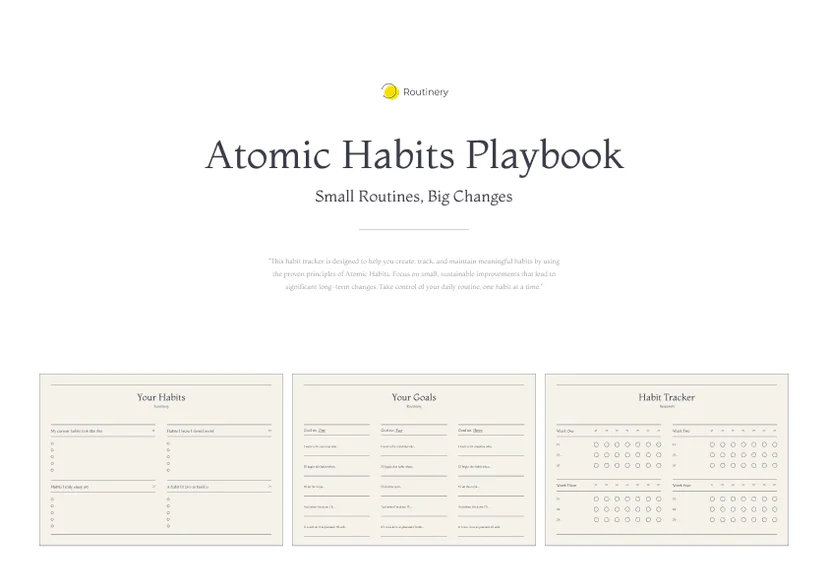
A new version of Atomic Habits Cheat Sheet
We all know how hard it can be to build habits. You start a new routine, feel motivated for a few days, and then... life gets in the way. Sound familiar? If you've ever tried to stick to a morning routine, workout plan, or even just drink more water, you've probably faced the struggle of staying consistent.
That's where the Atomic Habits Cheat Sheet comes in. It's a simple, science-backed tool that helps you take control of your habits, without relying on motivation alone. And the best part? You can download the PDF or PNG version right here to keep it handy whenever you need a boost.
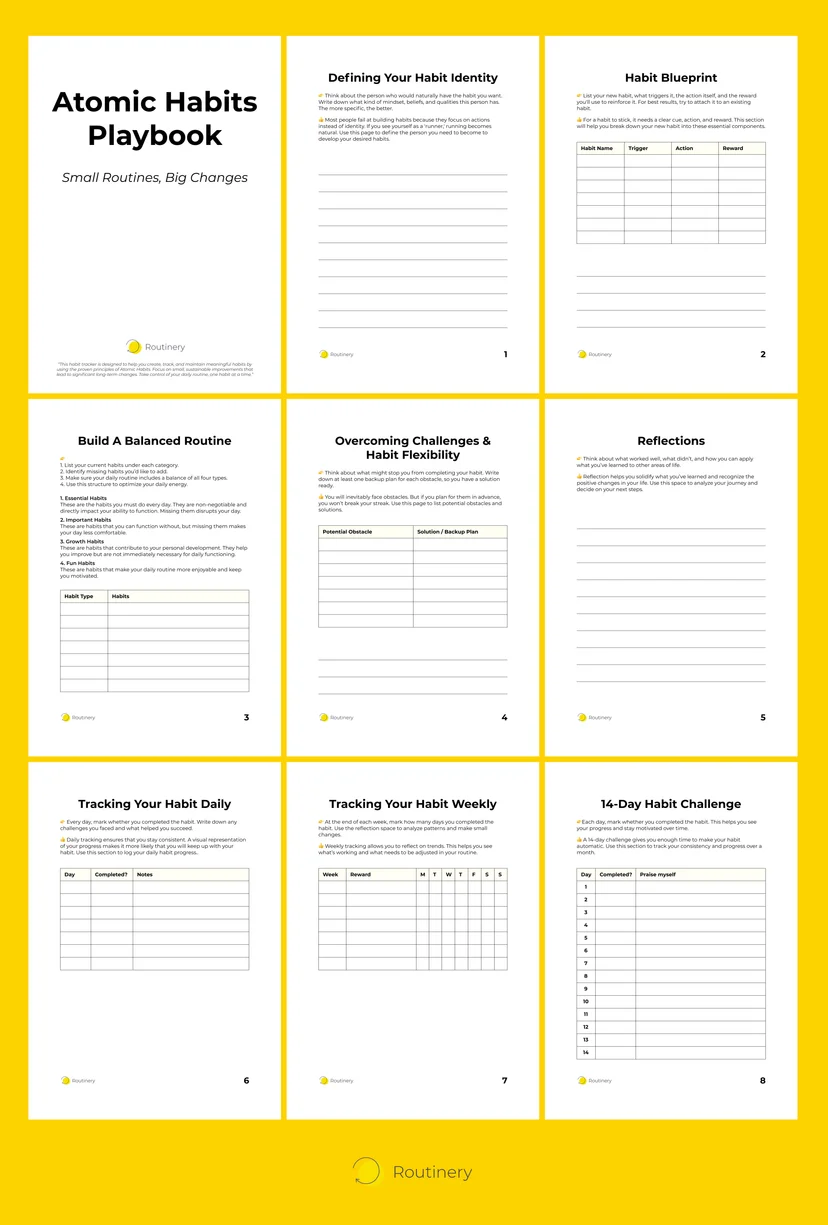
Enjoy the effects of the Atomic-habits-playbook.
🎁 Download Free Atomic Habits Cheat Sheet
Why this cheat sheet works: the behavioural science behind the four laws
James Clear's book Atomic Habits is built on the idea that small, consistent changes create massive long-term results. Highly recommend giving it a read, it's a game-changer! This cheat sheet takes those principles and makes them actionable. Here's how:
1. Cue-Action-Reward Cycle 🧠
Habits stick when they follow a loop: cue → action → reward. For example, if you want to start journaling, leave your notebook on your nightstand (cue), write just one sentence (action), and enjoy a moment of reflection (reward). The cheat sheet helps you design these loops for your daily habits.
2. Habit Stacking 🔗
Want to build a new habit? Attach it to something you already do. For example:
- "After brushing our teeth, we will meditate for one minute."
- "Before checking emails, we will drink a glass of water."
This technique makes new habits effortless because they piggyback on existing ones.
3. Make It Easy (Reduce Friction)⚡
If a habit feels hard, we won't stick with it. The cheat sheet helps simplify the environment so good habits become the default.
- Want to read more? Keep a book on your pillow.
- Trying to exercise? Lay out workout clothes the night before.
4. Track & Optimize Progress 📊
Tracking habits increases the chance of staying consistent. A simple habit tracker (like Routinery) can remind us to take small steps every day. The cheat sheet includes a mini tracker to help measure progress over time.
How Routinery makes habit tracking easier: the stack runs itself
A habit cheat sheet is a great starting point, but how do we ensure we follow through? That's where Routinery helps. Our timer-based routine planner takes the guesswork out of habit-building by guiding users step by step.
✔ Accessible on multiple devices - Unlike a printable cheat sheet that requires manual updates, Routinery works in real time on mobile, tablet, and even smartwatches, making it easier to integrate habits into daily life.
✔ Built-in habit stacking - The app automatically moves from one task to the next, notifying when it's time to switch. This structure makes habit stacking effortless because we don't need to decide what comes next, it's already planned. Plus, you can add small, easily achievable tasks in between, strengthening habits progressively.
✔ Reduces cognitive load - Checking the time, wondering what to do next, and tracking progress manually can be exhausting. Routinery eliminates this mental effort so we can focus entirely on the task at hand. This is especially useful for:
- Students who need to stay focused on study sessions.
- Busy parents juggling multiple responsibilities.
- Professionals managing a packed schedule.
- Teachers structuring classroom activities efficiently.
- Individuals with ADHD or OCD, who benefit from structured guidance and reduced distractions.
✔ Customizable micro-habits - With Routinery, we take habit stacking a step further. You can freely arrange tasks between your existing routines and edit them anytime. Plus, we provide micro-habit suggestions like clearing your laptop desktop, charging your smartwatch, or packing essentials before leaving home. Instead of wondering, What should I do before bed? or Did I forget something before heading out?, Routinery ensures nothing slips through the cracks with timely reminders.
Instead of just reading about better habits, we can actually start practicing them today, with real support.
Download: grab your free Atomic Habits cheat sheet (PDF and PNG)
Grab Your Free Atomic Habits Cheat Sheet (PDF & PNG)
Want a simple, visual guide to lock in better habits? Download the Atomic Habits Cheat Sheet here (PDF & PNG) and keep it where it's easy to reference every day.
💡 Pro Tip: Don't just download the cheat sheet, add 'Update Atomic Habits Cheat Sheet' as a recurring task in Routinery. That way, you'll never forget to review and refine your habits. Small changes add up, start today!
What's the first small habit you're adding to your routine?
🎁 Download Free Atomic Habits Cheat Sheet
CONTACT US: hello@routinery.app
Atomic Habits apps: what to use once the printout stops being enough
A printed cheat sheet is the right tool for designing a stack and the wrong one for running it every morning. The design work happens once. The running happens 300 times, usually while you're half awake, and that's where a sheet of paper asks you to remember what came next.
That gap shows up in the research on self-monitoring support. People managing themselves with no support held an adherence rate of 0.55, against 0.72 with tailored feedback and 0.83 with intensive support, and all three declined over 21 days with the unsupported group falling fastest.1 Paper is the unsupported condition.
| App | What it does with a habit stack | Timer | Price |
|---|---|---|---|
| Routinery | Stores the stack as an ordered sequence and runs it step by step | Yes, on every step | Free for 2 routines, $5.00/mo or $36.00/yr |
| TickTick | Habit section next to tasks, plus a Pomodoro | Session timer, not per step | Free (5 habits), $35.99/yr |
| Loop Habit Tracker | Records each habit as a daily check with a flexible score | No | Free, open source, no ads |
| Habitica | Turns the stack into quests and rewards | No | Free, optional subscription |
| Todoist | Recurring tasks standing in for habits | No | Free, $6.99/mo or $59.99/yr |
The honest split is this. If your problem is remembering to log the habit, a tracker like Loop is enough and costs nothing. If your problem is getting through a four-step morning stack without stalling between steps, you want the sequence itself timed. And if what keeps you coming back is points rather than progress, Habitica is doing something the others aren't trying to do.
Our best habit tracker apps guide compares these in more detail, and if you want worked stacks rather than a blank template, the habit stacking examples post has ready-made ones.
Frequently asked questions: the cheat sheet, the four laws and habit stacking
What is the Atomic Habits cheat sheet?
It's a one-page summary of James Clear's four laws of behaviour change, formatted so you can act on it rather than just read it. The sheet holds the cue-action-reward loop, a habit stacking template in the "after I do X, I will do Y" form, a friction checklist for making good habits easier, and a small tracker grid. You can print it, keep it on an iPad in GoodNotes, or use it as a one-time planning exercise and then move the stack into an app.
How do I use habit stacking from the cheat sheet?
Write the new habit directly after something you already do without deciding, then keep it small enough that skipping it would feel silly. "After I brush my teeth, I will meditate for one minute" works because the trigger is already automatic. This is the if-then structure that a meta-analysis of 94 studies found produced a medium-to-large effect on follow-through, d = 0.65.2 Stack one habit at a time and add the next only once the first runs without prompting.
How long before a stacked habit feels automatic?
Longer than the three weeks people usually expect. A review of health behaviour studies put the median at 59 to 66 days, with individual times ranging from 4 to 335 days.3 The spread matters more than the average here, because a habit that hasn't stuck at week three isn't evidence that the stack is wrong. Keep the sheet visible for the first couple of months, and expect missed days inside that window.
Do I need an app, or is the printable enough?
The printable is enough if the habits are few and the sequence is short. It stops being enough when you have four or five linked steps and keep losing the middle of them, because paper can't tell you what's now. The research above on unsupported self-management is the reason: adherence declined fastest for people with no support at all. Start with the sheet, and move to an app only if you notice the same step getting dropped.
Turn this into a daily routine with Routinery.
Step-by-step timers and cues that make routines stick.
Footnotes
-
Adherence by level of self-monitoring support: self-managed 0.55 (SD 0.38), tailored feedback 0.72 (SD 0.29), intensive support 0.83 (SD 0.20), all declining across 21 days. https://www.jmir.org/2025/1/e65431 ↩
-
Gollwitzer, P. M. and Sheeran, P. (2006), meta-analysis of 94 studies on implementation intentions, average effect size d = 0.65. https://doi.org/10.1016/S0065-2601(06)38002-1 ↩
-
Time to automaticity for health behaviours, median 59 to 66 days, individual range 4 to 335 days. https://pmc.ncbi.nlm.nih.gov/articles/PMC11641623/ ↩
Turn this into a daily routine with Routinery.
Step-by-step timers and cues that make routines stick.
🎯 Download Routinery Now — Try It Free for 7 Days →